Showing posts sorted by relevance for query museum. Sort by date Show all posts

Friday, 23 September 2016

A London Naturalist

The great thing about being a naturalist in London is the rich natural history and environmental culture within the city. Every day and night something is going on- yesterday evening I attended the National Park City  event at the South Bank Centre and tonight I went to a London Natural History Society talk about migration by Dominic Couzens. Tuesday night I was at a local Green Party meeting hearing a talk about how to get yourself arrested campaigning for environmental justice. Between the Natural History Museum, the Linnean Society, the London Natural History Society, the London Zoological Society, the Horniman Museum, the London Wetland Centre, the London Wildlife Trust, Rainham RSPB, various Universities events and lectures, the Arthouses and Galleries and an extensive network of smaller local groups/organisations, there is basically something going on somewhere all the time. A lot of the natural history research going on across the planet ends up being presented to London so there's always new and exciting stories being told across the capital. With such an intricate network of organisations, small groups and individuals, there's plenty of plotting, underground meetings and dealings going on all over the shop. 

With 13000 recorded species, London is one of the most biodiverse areas of the UK, 47% of London is green space, 19% of that is nature conservation habitat, there is a great network of reserves, LNRs, SINCs, regional parks and a little bit further out the Thames Estuary is a RAMSAR site. 

Its basically bloody brilliant being a London Naturalist. Also there's a long tradition of the naturalist community being in conflict with the Capitalists- the bankers, the industrialists and the corrupt courts so something's always kicking off too! 

.....and 30 mins to Gatwick from here to get access to the rest of the planet! (and on that note here's a superb blog post by the cutting edge biodiversity group working at the airport BIODIVERSITY GATWICK ) 

 The London National Park City Event yesterday evening 
 The LNHS talk by Dominic Couzens tonight
 The Natural History Museum- the Citadel of Nature
The wildlife garden here has a species list of something like 6000! (Unfortunately Capitalists which have infiltrated the NHM board want to build on it to increase consumer ((as opposed to increasing visitor engagement/impact)) numbers to the museum)
 The London Wetland Centre

Rainham- another nature temple in the city
The London nature reserve network is extensive- here's us 
 Regents Park- the London Parks are some of the best city parks in the world 
 Richmond Park and biodiversity improvements at the Isabela Plantation. 
 The Horniman Museum near Crystal Palace- a relatively hidden natural history gem
 London Zoo 
 Comforting to know I'm never more than 10 miles or so from a Hooded Pitta! (Plus all the other exotic flora and fauna which is present in the various London parks, zoos and collections) (Pic by Dingers) 
 Always plenty of courses to attend- this is one I took on grass id at the NHM
 Plenty of fairs and outdoor events- here's us at the Carshalton Environmental Fair
 Bioblitzes
 Marches
Nature themed Modern Art- one of my favourites -Marcus Coates
Great pro-nature bands and music- here's the Arcade Fire in Hyde Park
All the wildlife gardening going on over the city
The Eco-village of Bedzed. Within the Beddington Farmlands recording area. I could go on and on. 

Monday, 4 October 2021

Museum and musings

Zero birding and mothing done this weekend (weekends are reserved for family stuff now Jacob has started school but alas I try and sneak in stealth birding where possible). Saturday we spent local shopping (this is non-stop birding so even when we go shopping we go to local farm shops and independent outlets which are nature friendly) and on Sunday we went to the Oxford natural history museum to see some of the prehistoric marine reptiles and also some dinosaurs (and other natural history) which were collected from the local geology. Also downlaoded a geology app (Geology of Britain 3D) which is like apple maps for geologists. Apparently the Old Vic is on the Oakley Member sedimentary rocks (limestones and mudstones) which is below the Kimmeridge Clay, a late Jurassic sequence which is rich in marine deposits including plesiosaurs , pliosaurs , some dinosaurs and other Jurassic life- so the Old Vic is built on the bones of dinosaurs and marine reptiles which is nice to know considering how fanatical Jacob is about dinosaurs.   


A local Plesiosaur - this stuff lurks beneath our feet in Oxfordshire 
Saturday afternoon was spent preparing a whole batch of home grown food 
In the cafe on Sunday preparing the next five month plan for Little Oak Group

There was an interesting display at the museum called 'Meat the Future'. Interesting to see such a political display within a natural history museum and a thought provoking one. It seems like meat is becoming the fall guy for Capitalism with lefties going all in on the anti-meat/ vegetarian cause. Only the deluded can deny that industrial scale meat production is unethical and unsustainable however plant based industrial farming should not be getting such an easy ride either. Even if meat production is reduced (in western societies) it unlikely that will free up land which will go over to rewilding or nature conservation projects. It's more likely that will go over to biofuels, solar farms, wind farms, housing and intensive plant based food for humans- all of which are generally destructive to nature. It is also unlikely that the demand for meat in the developing world will be subject to the same lobbying as the west and demand is likely to increase. So basically reducing meat consumption is not some silver bullet that will sort out what is wrong in farming and nature conservation. The narrative is actually a very blunt blow and likely to cause blunt force trauma to nature conservation (while delivering more of a carbon reduction hit). 

Most industrial scale farming is destructive to nature whether plant based or animal based. We need sustainable/ethical farming in all its sectors. I've done a bit of work on this over the years and been involved in some experimental projects with my brother in Bulgaria See here  and also needless to say our own mini-farm at the Old Vic HERE. In short I would say that the best farming systems for nature are small scale independent farms which serve local/niche markets. Industrial scale anything often becomes unethical and while the world can support a certain percentage of 'unethical' anything its important that is kept in balance and it clearly offset and mitigated elsewhere. Currently we are far from 'in balance' with industrial scale systems dominating with an unfair advantage over the development of small and medium scale eco-farms.  

Meat production is often a vital part of those eco-farm systems and in many cases grazing animals are used as ecosystem regulators to manage habitat and are often vital for some species of birds too (Yellow Wagtails, Cattle Egrets! etc). Knepp Re-wilding project and Elmley National Nature Reserve (one of the UKs only family run NNRs) depend on grazing animals/livestock to effectively replace the lost megafauna (hunted to extinction by humans such as Bison and top predators such as Bears and Wolves) of the Western Palearctic in order to increase biodiversity by introducing that megafauna element to manage ecosystems (maintaining grasslands, scrub and keeping back succession ) with humans and farming acting as 'Apex Predator' and regulating the herds by meat production. The economics of this works better too. 

While I fundamentally support the idea that the public should be eating less industrial produced meat I don't support the way that this is being driven partly by an animals rights agenda where some people are wearing the climate change cloak but hidden beneath that is an ideology which is against eating meat and where they believe that the 'food web' is unethical and they promote plant based food (even if those plant-based foods are unethical and destructive to ecosystems). I also find that idea quite irrational as animal rights are also tied up in the destruction of ecosystems (all those animals from invertebrates to top predators are denied the right to even exist in an industrial scale plant based system) There is a conflict between animal rights and nature conservation, just as there is a conflict between climate change politics and nature conservation politics - look at windfarms and solar farms- not great for nature either! As a naturalist I believe my main objective is to work out the ways which are best for nature- not for human belief systems or 'green' industrialists. 

So basically, I'm a bit wary of this populist vegan/ vegetarian movement and maybe shouldn't have been surprised to see it at the Oxford Natural History museum. I guess the museum if funded by the Capitalist system somehow and is part of traditional society (colonial, committee and social hierarchy based) then promoting plant based diets is a way of releasing planetary stress while maintaining high levels of humans living in overcrowded nature impoverished environments which are then put to work in capitalist industries which then fund museums and NGOs. It a form of class oppression using environmental politics to sustain it. 

There's got to be a better way and there is- its what I might call the Third Way. The way we do it. It's neither the right wing blatant nature destroying raw capitalist organisations or the left wing NGOs being funded by them and in their pockets by exchanging greenwash for social licence. The third way is  independent free regular citizens taking full control of our own environment, running our own businesses on our terms and our principles, trading within an ethical network, supporting other small and medium sized ethical business and largely detached from large scale industrial systems (which have their place but in moderation and in balance). Its basically a hack, a by-pass of the main system and building a concurrent/alternative society- one that can grow big and strong enough to mitigate/offset destructive unethical practises.  It would be better if the NGOs linked into that community more and sever unethical ties with big business and dead capitalist's legacies. 

Being part of that community and helping that community grow is also the best way of bringing balance to corporate led run away system.... while not being pulled into their simple narratives that use fall guys (such as the meat industry which will grow anyway from new markets opening up in the developing world ) to distract from what they are all up to, which is basically dodgy business as usual with  corporations, NGOs, museums, charities; all  manifestations of the GDP paradigm, a paradigm which is fundamentally all about making money whether openly or covertly,  a paradigm which is finally coming to an end, even if that end is just a personal choice to detach from the dodgy bits of it.   

Monday, 14 December 2020

A day in the city

We took Jacob into Oxford today to see the dinosaurs at the Natural History Museum. After our visit there we walked round University Parks where I added Ring-necked Parakeet and Nuthatch to my Oxfordshire list (now on a humble 155).

At the museum there was an interesting section on the London Clay Fossils from the Isle of Sheppey that reminded me of my plan to visit there in the hope of finding fossil bird remains (would be great to add to my list of bird finds). I've been doing a bit of research this evening on the palaeontology of the area and some of the bird fossils found to date SEE HERE . Bird fossils are very rare in the London Clay, but it's still one of the best places in the UK to search for fossil birds. The London Clay here is very rich in other fossils sourced from both an ancient shallow sea and fossils washed in from a nearby tropical shoreline including sharks teeth, lobsters, crabs, fish bones and skulls, fossilised trees/wood, seeds of mangroves and palms, gastropods, a range of interesting trace fossils (borrowing worms, lobster tubes etc) and of course the odd bird and even mammal. The London Clay was laid down in the Eocene, about 50 million years ago (so 15 million years after the last non-avian dinosaurs were wiped out).  

Jacob meeting Triceratops (above) and T-rex (below). 

Some stunning Trilobites and a fantastic selection of fossils on display 
The highlight of any city trip is a visit to the city's Natural History Museum. I've visited a few in this blog  (See here ) including London NHM (including Tring and the Cocoon), the Horniman Museum, the Belgrade/Serbian NHM, the Sofia/Bulgarian NHM and the Philadelphia NHM.     
The duck pond at University Parks- an Otter was frequenting here recently. The Ring-necked Parakeets (not an easy bird in these parts) were in this area. 
 

Friday, 16 February 2024

Madeira Days Four and Five

Yesterday we explored the central part of the island and had lunch at Santana and I also had a couple of opportunities to check out the gardens in our local area. Today we visited the Natural History Museum at Funchal before coming back to the cottage early as poor Jacob has a dose of food poisoning.  Popped into Lugar de Baixo on the way back- Common Sand and Glossy Ibis were trip ticks. While Holly played nurse I popped up to Risco and walked down to the restaurant hoping to get some photos of Trocaz Pigeons. Unfortunately no Pigeons but plenty of local birds and stunning scenery. 

Live Trip report HERE  

Canary Island/ Madeira Kestrel
Madeiran Firecrest
Male (above) and female (below) Madeiran Chaffinch 

European Robin
Zino's Petrel at the Natural History Museum 
Trocaz Pigeon at the museum- I still need to get a 'real' photo of one of these 
Island Canary 
Male Monarch (prominent sex band on vein 2 of hindwing) - quite a few of these in the wonderful little natural history museum garden 
Central Madeira 
View over Risco 
Sunset above the clouds 

Wednesday, 16 January 2013

Inner London Day Trip

Hyde Park Beardies


Kensington Gardens waterfowl
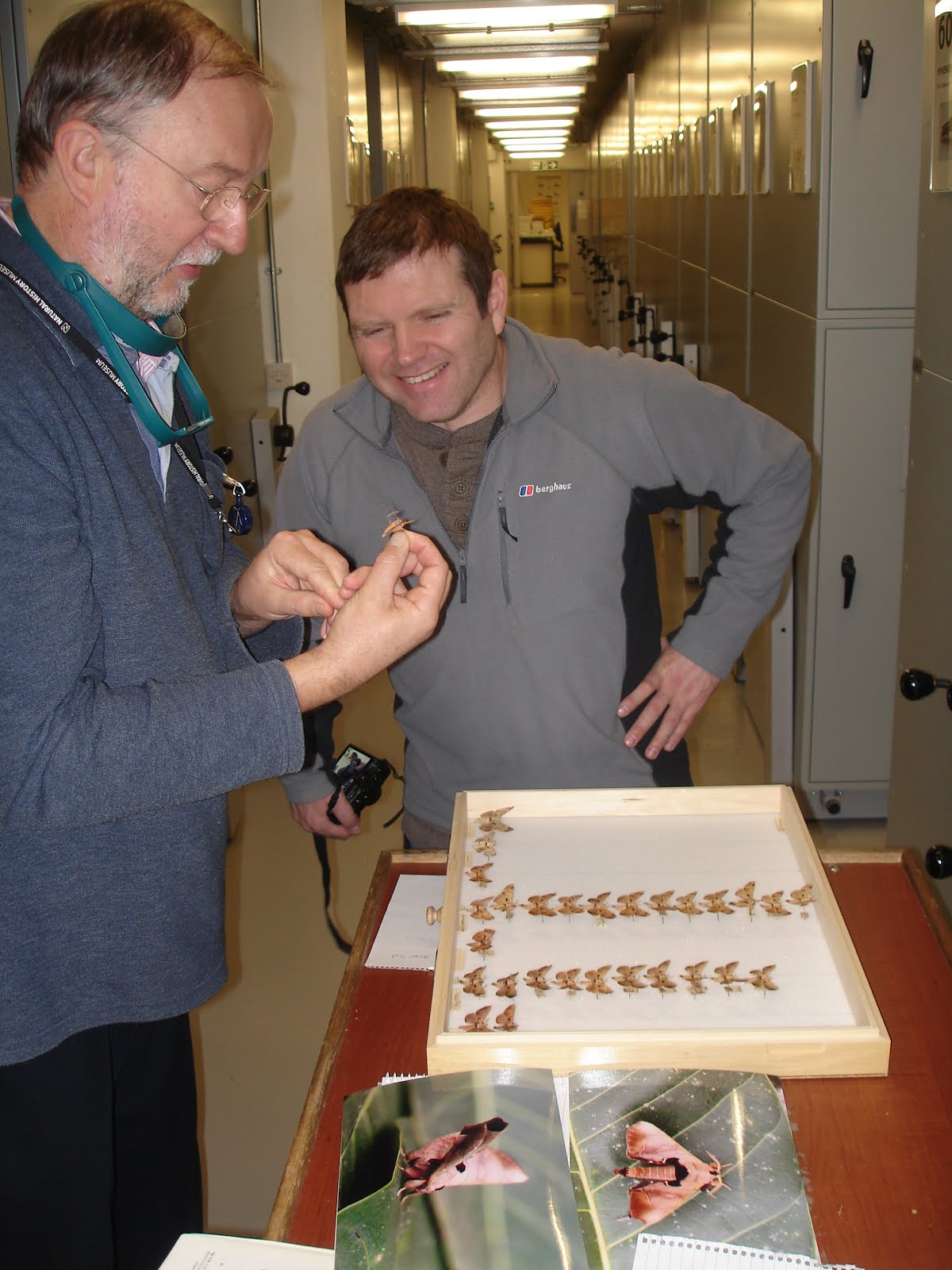
Dingers and Martin Honey (Lepidoptera curator at NHM)
The Cacoon- 12 million entomological specimens stored here

Lee had discovered an unidentified moth while working in the Brazilian rain forest so we took some photos of it to the Natural History Museum to see if we could find it in the specimen collection. With the help of the museum curator we managed to identify it and Lee is going to do some more investigation to see if it has been recorded in that area before.
On the way to the museum we stopped off at the Beardies in Hyde Park. Good to see Hyde Park Gaurdian Des McKenzie,  and also quite a good selection of waterfowl on the Serpentine including quite a few Shoveler.
More on today from Lee here:

Saturday, 4 April 2015

Easter Holiday


Polly Morgan bringing a modern twist to taxidermy and natural history displays (More here) 

It's holiday time which means family days out. Good Friday we went to the Horniman museum and Gardens at Forest Hill.  A good natural history collection and some cultural stuff too, collected by old great and good Frederick Horniman, who built a public museum to show off his bling and try and educate the public too (nobody's still quite cracked that one!).

Artist Polly Morgan had a display using stuffed animals- the kind of stuff that if your mate was showing you that he'd made in his bedroom and wasn't for an art house or museum- you'd fear for your safety. Needless to say, right up my street- loved it.

Looks like the Tickell's Thrush in the collection is wrongly labelled (looks like a Black-throated to me).

A must see on the London natural history circuit.

HORNIMAN NATURAL HISTORY COLLECTION

 Easter Sunday at Richmond Park with Rachel and Sue- nice little bit of habitat recently been created in the Isabella Plantation
Easter Monday- family walk round Little Woodcote. Buzzards and Peregrine and added a few more species to Sid's Bioblitz list SID's BIOBLITZ