Showing posts sorted by relevance for query Caspian Gull. Sort by date Show all posts

Friday, 24 March 2023

Azerbaijan Gulls

A few gulls pictures from our recent trip below. Full trip report here 

The most interesting observation was a large flock of apparent Steppe Gulls, Larus (fuscus) barabensis. According to Peter Adriaens (author of the Gulls of Europe here, also the reference for the photo comments below), these would be the first fully confirmed and documented records for Azerbaijan.  Will write up a short note for Dutch Birding with more details, in the meantime here's a few introductory photos below. 

2 adult and a first-winter Pallas's Gull - nice and easy to identify! 
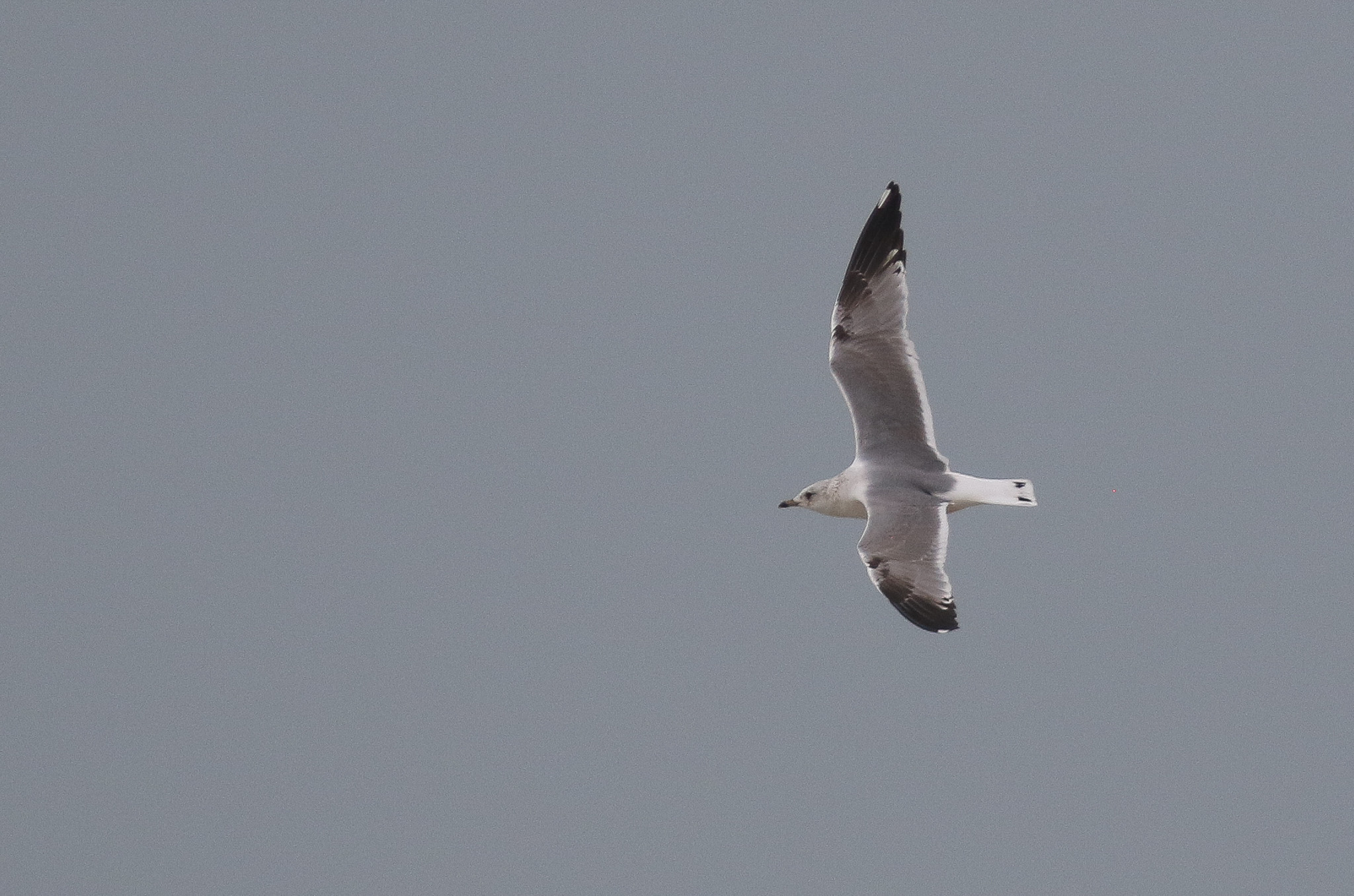
Second-winter Common Gull, the extensive black in the wing, lack of mirror on p9, a relatively large dark mark on p4 and dark markings in the tail (there may even be a couple of dark markings in the secondaries) could indicate Russian Common Gull although the head doesn't appear particularly white or shawled (a distinctive boa). The bill also doesn't appear particularly yellow which is indicative of Russian Common Gull. A diagnostic second-winter Russian Common Gull should have a combination of features that includes the white head and boa, yellow bill, black marks on inner and outer webs of p4, a lack of mirror on p9 (or confined to inner web), no white tongue-tip to p7 and a blunt tip to black wedge on outer web of p7. This bird doesn't show all those features so is presumably an intergrade.   
First-winter Common Gull (Vincent Legrand). The bright bill, clean white underparts, white underwing with dark broad primaries and secondaries trailing edge and shawled neck suggests Russian Common Gull . A less marked underwing and a more white head with a distinctive boa would be more typical of Russian Common Gull. 
Adult Caspian Gulls. Ironically the Caspian Gulls in the Caspian Sea are not as distinctive as the western populations of Caspian Gulls (also known as 'Pontic Gulls'). The Western birds have more white in the primaries whereas those in the Caspian Sea have more variable and often more extensive black in the wing-tips
Adult Caspian Gull (Vincent Legrand) 7 marked primaries (usually 6) but characteristically has the long white tongue on p10 and grey tongues with white tongue tips on other primaries too 
Adult Caspian Gull (Vincent Legrand), showing 8 primaries with dark markings . Also the tongues on the outer primaries are not typically long. A bird like this could be considered within variation of Caspian Gulls in this region but there were also suggestions of an intergrade type between Caspian and Steppe Gull. 
An adult Caspian Gull landing in a flock of apparent Steppe Gulls, showing the paler upperparts, extensive pale tongues in the primaries with white tongue tips, pale tip to p10 and the duller coloured legs 
Presumed adult Heuglin's Gull (foreground) within a flock of mainly apparent Steppe Gulls (and some Caspian Gulls). Looks like a few other Heuglin's Gulls in the background and perhaps a 2nd winter Caspian Gull (duller legs and perhaps slightly lighter upperparts) second bird left of foreground Heuglin's.  
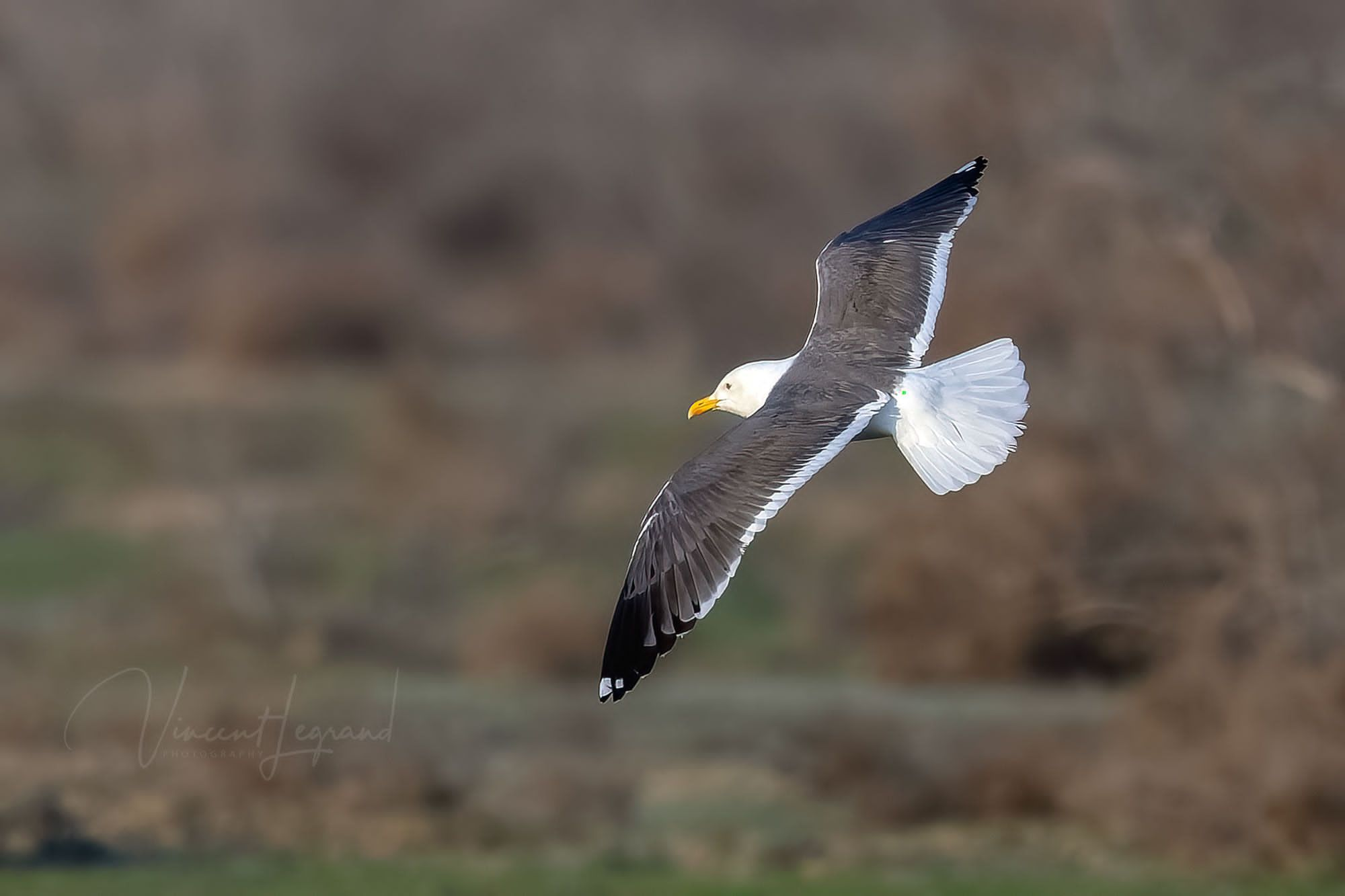
Presumed Heuglin's Gull (above and below) by Vincent Legrand. Identification based mainly on location (although graellsii has recently been confirmed in Israel from a ringing record). Also the white tips to the grey tongues on the primaries are indicative of Heuglin's Gull. A more typical wing-tip pattern for Heuglin's Gul is a the p10 mirror separated from the tip by a broad black subterminal band (so the mirror sits far from the wingtip) and no mirror on p9. Also on the underside (below) the tongue to p10 is typically white (it's grey on this bird). 

We came across this very interesting flock of gulls (above and below) near Baku on the way back from the Caucasus. The upperpart colour was pretty dark, seemingly darker than expected for Caspian Gull with a dark bluish-grey upperpart (more pale grey in Caspian) but not as dark as the presumed Heuglin's Gulls in the flock (of which there were several). The bright yellow legs were also not right for Caspian Gull (Caspians have dull yellow legs even in summer plumage) and are more indicative of Steppe Gull. 
Some interesting immature plumages in there too. First-winter Steppe and Caspian Gulls are virtually identical. 
One Heuglin's Gull  (centre right) and apparent Steppe Gulls- the amount of black in the wing on the apparent Steppe Gulls is too extensive for typical Caspian and the tongue on p10 on some birds in short and wide (a feature of Steppe Gull). 7 primaries have dark markings on most of these birds and the p10 mirror is separated from the tip by a broad black band. The black on the outer webs of the outer most primaries also typically reaches further to primary coverts with short grey bases (unlike Caspian). 
Heuglin's Gull (centre right) and apparent Steppe Gulls 
More shots of the same group, apparent Steppe Gulls and a few Heuglin's Gulls 

Presumably a first-winter Steppe Gull (left centre), although some of these first-winter birds in this flock could also be Caspian or even Heuglin's Gull which are also similar. Unfortunately we couldn't get many better photos of these birds because we were moved on by security as these gulls were resting in a police controlled area (a prison or military area). 

Thursday, 11 December 2008

Gull sp.

Here is another photo of a large white headed gull which I have chosen to label 'Caspian-type'. As this bird has generated a little bit of discussion I got a bit worried and gave it some more thought.

The reason why I think this bird is not a 2nd Yellow-legged Gull is as follows: a) Lacks a darkish 'eye' mask thus appearing distinctively 'white-headed'. b) p10 mirror in 2nd win is a Caspian feature and not Yellow-legged Gull, c) structurally I interpret this bird as being 'long-necked' and perhaps even small headed, not much of a tertial step and maybe even a hint of a full breast- all more Caspian features but I wouldn't put too much emphasis on my subjectivity with structure on a bird like this d) Also perhaps the dark tip, pale based bill and dark eye- maybe (?) pointers towards Caspian.

To my eyes, I don't think there is too much to suggest argentatus- the white head, dark eye, lack of blue grey in the upperparts, structure etc but some people have suggested they can see argentatus in it.

Therefore, as it shows Caspian features- why not a Caspian. Well, I would prefer not to call anything a Caspian unless it is a classic. Malling Olsen and Larsson's 'Gulls' deal with Caspian Gull- condensing a lot of independent papers and discussions into a concise summary- so I think Caspian Gull identification has become easier in recent years. Basically if it don't look like the birds in plates 42 and 43 it isn't one. I cant find this latest Beddington bird in this book- so...good night to that particular bird.

This book has even been endorsed as 'high standard' by the BOURC Taxonomic Sub-committee (TSC) (BB:101 pg 344) so I think can pass for 'scientific'. Although I am not too sure if my game of 'snap' qualifies as such.

That may be over-simplifying things but there are still gaps in knowledge about the variation within Caspian Gull and there appears to be hybridisation between Herring (argentatus)-Caspian at least in central Poland and also there are birds showing mixed characteristic from the Volga to Scandinavia. Therefore it appears a good idea to be cautious when assigning the name Caspian Gull unless it is a classic. The sink term 'Caspian-type' is a bit of a cop out but just points towards Caspian when it shows more features than say Yellow-legged so maybe a convenient way of logging these birds. Perhaps it is even more appropriate to call this bird gull sp. but personally I feel we can narrow it down just a little bit more. Of course, I could be wrong.

Saturday, 30 January 2016

Gull Workshop


First-winter Caspian Gull 
  Gull workshop group  (photo by Lukas Becker)
Photo Lukas Becker 

Had the gull workshop today. 11 people took part, we looked at species identification, ageing and variation within the regular gulls at the farmlands and Martin found a first-winter Caspian Gull which was a lifer for a few of the group.

We had Herring Gull, Lesser Black-backed Gull, Great Black-backed Gull, Common Gull, Black-headed Gull and Caspian Gull.


LAST NIGHTS BBC WINTERWATCH WITH DAVID LINDO- GULLS AT BEDDINGTON FARMLANDS, FEATURING THE RECENT FIRST-WINTER ICELAND GULL - from 35 mins HERE

BEDDINGTON FARMLANDS GULL HIGHLIGHTS HERE


Tuesday, 3 January 2017

Gull Run

The good gull run continues. Today we (David Campbell, Dave Stanebridge and myself) had 1 first-winter, 1 second-winter and 2 adult Caspian Gulls, 1 second-winter Yellow-legged Gull and some interesting hybrid-types. Also a handful of 'Northern' Herring Gulls (argentatus).

 Adult Caspian Gull ( Bird 1 above and below) 

 Adult Caspian Gull (Bird 2) 
 Second-winter Caspian Gull (looks like same bird that has been around a week or so) 
 First-winter Caspian Gull
 Second-winter Yellow-legged Gull


 Presumed hybrid Lesser Black Backed Gull x Herring Gull? 
 Another presumed hybrid (behind Great Black Backed Gull) 
'Northern- type Herring Gull with extensive head markings
A Red Fox from a couple of days ago. Walked right up to me. 

Saturday, 23 February 2013

Beddington Farmlands Gulling Highlights

The end of an era on the Horizon
The decision regarding the development of an incinerator at Beddington Farmlands will be made in the next few weeks and looks pretty much a done deal. This means the end of the Gull era at Beddington is on the horizon- possibly within five years. That means we've got five years to find an American Herring Gull, Ring-billed Gull, Bonaparte's Gull, Armenian Gull, Great Black-headed Gull etc etc.

With the end in sight it's also an opportunity to reflect on what has been found since tipping commenced (in 1998). Top prize goes to the Glaucous-winged Gull in April 2007 (a first for Britain which had been seen earlier in the west country) and second prize might be another Glaucous-winged Gull- a first-summer bird seen in April 2009 which is still under consideration by the BBRC.  Other highlights have included two 'Kumlien's Gulls', three juvenile Sabine's Gulls (together) and a bag full of Caspian Gulls, Iceland Gulls (33 records), Glaucous Gulls (21 records), Yellow-legged Gulls, Mediterranean Gulls, Little Gulls, Kittiwakes and plenty of headaches, hybrids and unknowns.

Here's a few personal highlights:

Second-winter Iceland Gull, one of thirteen Iceland Gulls recorded in the winter of 2011/2012 
First-winter Caspian Gull- a Beddington speciality  
First-winter Kumlien's Gull, present from November 2011 into 2012 
Putative Glaucous-winged Gull/ Pacific hybrid (210409)- still in circulation with the BBRC 
Putative Baltic Gull (191211)- can these be 'done' without a ring to confirm? 
Adult Mediterranean Gull- a regular winter visitor and post breeding migrant 
First-winter Glaucous Gull- a near annual winter visitor 
Iceland Gull with Herring and Black-headed Gulls 
Adult Yellow-legged Gull (top- with adult Herring Gull) 
Adult Caspian Gull (off centre bird) 
Juvenile Sabine's Gull, October 2007

and here's the big one that got away -(apart from for two fortunate observers, Garry and Johnny) :

Third-summer Glaucous-winged Gull 180407 (Garry Messenbird)

Wednesday, 30 November 2016

Gull season


Started off the day looking for Barn Owl pellets with Tomos. The nest site (we had a breeding pair this year!) was very clean but we did find what must be a roost site with plenty of pellets. Marcus also says he found some in the Storm Tanks. With three young and the adults presumably there are at least five birds in the area (assuming no mortality yet). Hoping to go owling on Sunday night and will dissect some of the pellets asap.

Went under the tunnel and counted the hibernating Herald moths before heading over to join the gang on the viewing mound looking at the gulls. 

 Polish ringed Caspian Gull or Caspian Gull hybrid. Pic by Kojak Kojak's blog
 'Second winter Caspian-type' 
 Caspian looking Yellow-legged Gull. The anaemic looking leg colour and rangy structure suggests something not straight forward  
 Wing-tip pattern reveals extensive dark in wing tip closer to Yellow-legged Gull. (same bird as above) 
 First-winter Common Gull (canus). Following on from Peter Adraiens and Chris Gibbins recent paper on Common Gull complex identification in Dutch Birding, hoping to find a 'Russian Common Gull' (heinei)  at the farmlands. The most distinctive feature to look out for on one is a completely white head with a dark streaked boa- a bit like a mini- Caspian Gull head (unlike the streaked nape and crown of this bird) 
 Heavily marked juvenile/first-winter Common Gull (canus) 
 Second winter Common Gull. Using the key on pg 25 of DB 38:1; p9 outer web with all black base, p4 with one black spot on one web only= canus. 
 Adult Common Gull. Using key on pg 18 of DB 38:1. p9 without obvious white tongue-tip, p5 with broken black band, p7 with white tongue tip, p8 with grey at base of outer web, p9 with large mirror (larger than black tip) = canus 
 Gulls over Croydon 
Adult male Wigeon (right) with extensive white in coverts and two first-winter males with reduced white 
Red Kite over the viewing platform today (with an unusual extensively white head) 
Heralds in the tunnel. Tomos and I counted 23.