Thursday, 10 February 2022

The Azores, Winter trip 2022, Day Three

Another great day on Terceira. I covered the Lagoa do Junco area today. Updated Ebird Trip Report HERE. Highlights included a couple of Azores ticks, Common Crane (2 adults and a young bird) and Marsh Harrier.  Had a good count of 13 Mediterranean Gull and had a few trip ticks including Mallard, Common Waxbill, Semipalmated Plover, Snipe, Common Sandpiper and Cory's Shearwater. 

I checked out the old rubbish tip which is now closed and replaced with an incinerator. Seems like it has had an impact on the number of wintering large gulls as I didn't see many Azores Gulls. We used to do winter gulling trips out here and found some great birds but this year there just aren't many large gulls at all. American Herring Gull used to be more or less guaranteed (often multiple birds) and white-wingers were often recorded. The number of Ring-billed Gulls also continues to fall since our first winter trips out here (from over 30 to only 10 or so now).

In the afternoon I did the quarry, the harbour, the bay, the beach and finished up at Paul da Praia to see the 95+ Glossy Ibis come in to roost. There were also 50 Azores Noctules hawking over the ridge. 

The family of Common Cranes, two adults and one juvenile

Marsh Harrier (on right) and Azores Buzzard
Least Sandpiper
Semipalmated Plover. There were about 8 'Ringed Plovers' in the quarry today, it looked like about four of each, Semipalmated and Ringed Plover. Some looked quite intermediate but this bird shows all the features, complete breast band, yellow eye ring, dark lores above upper mandible with a distinctive gap above base of bill, orange base to lower mandible and the distinctive call
A vagrant male Pintail- stunning at the best of times but in a vagrant context, extra special
Mallard is not a common bird on the Azores. There are plenty of domestic Mallards in groups of farmyard Geese and Muscovy Ducks. Ruben and Co believe this a good candidate for a wild bird. Plumage wise seems okay.  
Greenshank
Kentish Plover
First-winter Mediterranean Gull with Ring-billed Gulls
Glossy Ibis at dusk at Paul da Praia   

Wednesday, 9 February 2022

The Azores, Winter trip 2022, Day Two

 Been experimenting with the new Ebird Trip Report function today. See here for trip report so far HERE (Best viewed by clicking on Show All Details).

Bird of the day was a Swift sp flying high over Paul da Praia. Almost certainly a Pallid Swift with noticeable large white throat patch and looked brownish in the strong light. The flight was relatively tardy too and the wings appeared rather blunt-tipped. Unfortunately Ruben's camera couldn't focus on it and when I took my bins off it we couldn't find it again. A few hours later a couple of House Martins appeared in the same area suggesting there was some kind of very early Spring movement occurring of aerial feeding birds , in the high pressure and north east winds. Iberia is being affected by an unseasonal heat wave at the moment so these rather unprecedented early Spring migrant sightings may be explained by the atypical warm weather. I need both Common and Pallid Swift for the Azores so an Azores tick either way but considering the time of year in addition to the impression, it was almost certainly a Pallid.

Other highlights included seeing the two Spotted Crakes that have been around, the Water Rail showed again to the delight of all the locals that needed it, a winter plumaged Least Sandpiper in the quarry, the Bonaparte's Gull again, at least 8 different Med Gulls, Great Northern Diver, 3 Sandwich Tern and the Belted Kingfisher again. 

Tomorrow I'm exploring other parts of the island and looking for a few Azores lifers that have been around. 

One of two Spotted Crakes on Paul da Praia 

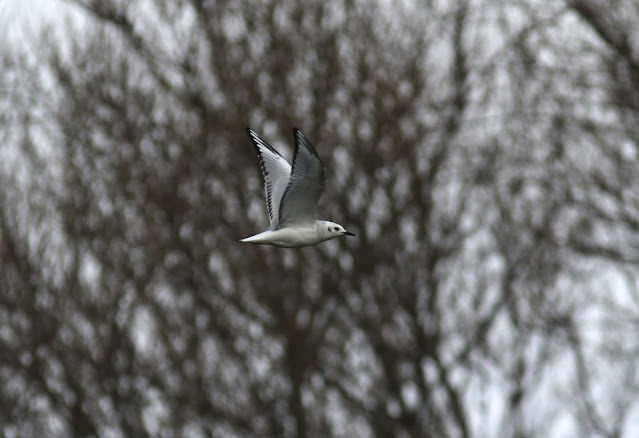
The first-winter Bonaparte's Gull 
Med and Black-headed Gulls . There was at least 500 Black-heads coming into roost in the harbour this evening. The choppy harbour waters in the north east wind made it difficult to scan through them but there presumably has to be something else in them apart from the one Bonaparte's ?
Adult and first-cycle Azores Gull- for our paper on Azores Gull identification see HERE

Azores Noctule (endemic)- had 15 of this day flying bat, over the ridge from Paul da Praia this evening 
I believe this is Madeiran Wall Lizard, an introduced species . As far as I'm aware, this is the total herp list for the Azores HERE, although I had what sounded like Marsh Frogs today at Belo Jardim- will check that out. Also had Clouded Yellow and Red Admiral today and a brief view of a dragonfly. 
Stunning view over Praia da Vitoria area. I've literally just birded this area for the last two days. Venturing further afield tomorrow. 

Tuesday, 8 February 2022

The Azores, Winter trip 2022

It didn't take me long to remember why I love the Azores. Within two hours of getting off the plane at Terceira I had seen this lot HERE and HERE, one WP tick and two Azores ticks already in the bag. 


This stunning Belted Kingfisher has been around since October 2021. An Azores tick. 
First-winter Bonaparte's Gull, this bird has been around for a while
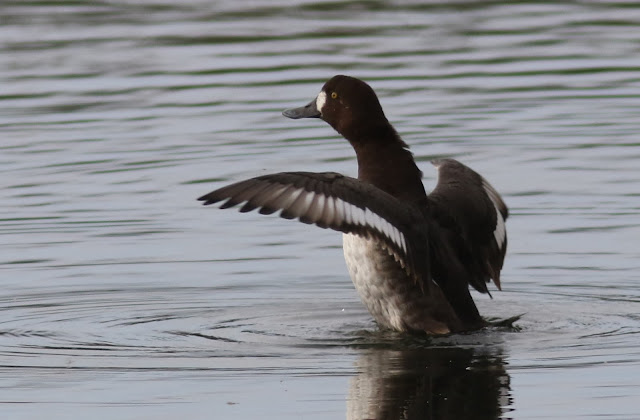
Male and female Greater Scaup (above and below) and a male Lesser Scaup. The male Greater Scaup is quite slight built with rather dark heavily vermiculated upperparts. I mistook the female for a Lesser Scaup at first but the wing bar (white secondaries grading into the primaries, below) is right for Greater Scaup. The American race of Greater Scaup (Nearctica) is supposed to be more Lesser Scaup like so it's worth considering that possibility. The male and female arrived together in November and the male Lesser Scaup appeared in December. There is another pair of Greater Scaups on the island too. Up date 090222- Peter Stronach (Highlands area recorder)  has commented on twitter that the hollowed out head shape and the dark lower scapulars on the male would makes these birds 'stand out a mile' in the flocks of European Greater Scaup they get in Scotland.  

Male Lesser Scaup (left) and Greater Scaup 
Another wildfowl conundrum - a male Green-winged Teal presumably with a female of the same species . However the female shows a mix of features. The head pattern is quite strong (a supercilium with a hint of a loral spot) which is good for female Green-winged Teal but the orange at the bill base and the pale speculum borders, particularly the white tips to the greater coverts, are European Teal features. Update 090222- Peter Adriaens kindly informs me that the tertial pattern confirms this as Eurasian Teal, with the complete black outer edge and overall plainer tertails. 


Female European and male Green-winged Teal?
These were easy to identify! Ring-necked Ducks.
Found this Water Rail, the first on the Azores since 2013 and only the 8th record for the Azores. It sparked a local twitch at dusk, back tomorrow to help Ruben and Co find it. 


There have been up to 13 Ring-billed Gulls around this winter, the usual wintering flock that is best seen at dusk in the pre-roost on Praia da Vitoria Beach. I could only find 10 birds, 6 adults and four first-winters. Also four Common Gulls. 
Paul da Praia 
There's up to 130 Glossy Ibis on the island at the moment, most of them roosting on Paul da Praia 

Monday, 7 February 2022

Latest from the Old Vicarage

Slow at the Old Vicarage at the moment. The 2022 bird list is up to 47 species HERE  and the moth list is still stuck on one. New birds recently include a Moorhen calling at night and Mallard on the neighbours pond. Greenfinches are singing now (up to six around), Jackdaws continue to prospect in the Walnut, the Grey Wagtail is still around, more birds are singing now (Chaffinch started up today), Siskins are still gracing the garden, there are up to three calling Green Woodpeckers and two Great Spotted Woodpeckers. Redwings and Woodpigeons are feeding in the sheep field and the partially leucistic Redwing is still around. 

We've bought a few wildlife supplies for the year ahead including some pheromones and pheromone trap to try for Clearwings this year, bought 10 survey matts (to try for herps and small mammals). On the wider projects front also bought six volumes of Leraut's Moths of Europe (for some trips this year). Got a couple of trips coming up soon; leaving for the Azores tomorrow and then at the end of the month heading over to Azerbaijan in search of 'Omid', the last Siberian Crane in the Western Palearctic.

Meanwhile in-doors, plans are afoot to create a Paludarium to add to the mini-zoo and we've been researching this. The plan is to create an indoor mini bioactive rain forest with tropical plants, fish, lizards, amphibians and inverts. Will attempt to create some kind of self regulatory elements to it. We discovered what could be a Malaysian Trumpet Snail in the aquarium (a stowaway) and also added three Glowlight Tetras. 

Adult Common Buzzard (above and below) 

Female Siskin 
Wren- more birds are showing territorial behaviour with a good dawn chorus now
Green Woodpecker- up to three of these calling and fighting 
Mallard on the neighbours pond- handy that they've created this pond, saves us a job as we can access it and see it easily, should be interesting what turns up on this, this year  
Redwings in the Sheep Field 

Wednesday, 2 February 2022

Surrey Bramblings

I had a couple of tree management plans to do back in London today so got them finished in the morning and headed over to check out the Brambling flock near Reigate that has numbered over 1000 birds in recent days. I had about 400 but that was spectacular. Also great to bump into Steve Gale (Steve's North Downs Blog here)   who showed me round this part of the North Downs. Ebird list HERE. 


Winter Aconite 
Winter Heliotrope. There was also some Lesser Celandine and the odd Primrose out. Also had a Winter Shade moth on the way home from the cinema this evening. 

A couple of views over the diverse environment of the North Downs. This fascinating area has hosted some spectacular ornithological phenomena in recent years including being the epicentre of the 2018 national Hawfinch invasion More here and witnessing some of the largest numbers of migrating Redwings in the country last autumn (nearly 35,000 in nearby Leith Hill) and now probably one of the largest concentrations of Bramblings in the country. There must be something special about this area which Steve and I discussed. Presumably something to do with the diverse mosaic of habitats and relief (yew covered chalk escarpments with mixed woodland, farmland and cover crops on shooting estates) and a series of migration flightlines (along the North Downs and Greensand Ridge) , various bottlenecks through the ridges and the proximity to the narrow sea crossing between Belgium and Essex/Kent with birds migrating across there and then following the Chalk and Greensand Ridges which bring them to the good habitat in this area. The nocturnal crossings from the Continent often bring the birds in this area towards dawn which often accounts for some of the highest counts of Redwings  inland (as they presumably went over Kent and Essex under cover of darkness and unseen by vis-miggers). That timing of appearing in this area at dawn could also help concentrating birds in this area as they seek to re-fuel following nocturnal migration. The southerly (and more mild) location could also concentrate birds that have trickled down the country. All these factors combined may partly explain what's going on here.  

Tuesday, 1 February 2022

Archive Lifers

I was working out my mammal and reptile WP list today and went through some old trip pics to see what I've actually seen. So turns out I've seen Starred Agama, Laudakia stellio (found a photo and identified by Pierre- thanks!) and if identified correctly also Rock Hyrax and Nubian Ibex in Israel 2016. 

So now my WP lists are Birds on 706, Mammals on 95, Moths on 778 and still need to work out my Butterflies, Dragonflies and Reptiles & Amphibians lists. Should be lots of lifers lurking in my old photos. 


Starred Agama
Nubian Ibex (female) 
Rock Hyrax